Sep 2, 2026
Cobblestone Bath Mat: Which Material Is Best for Daily Use?
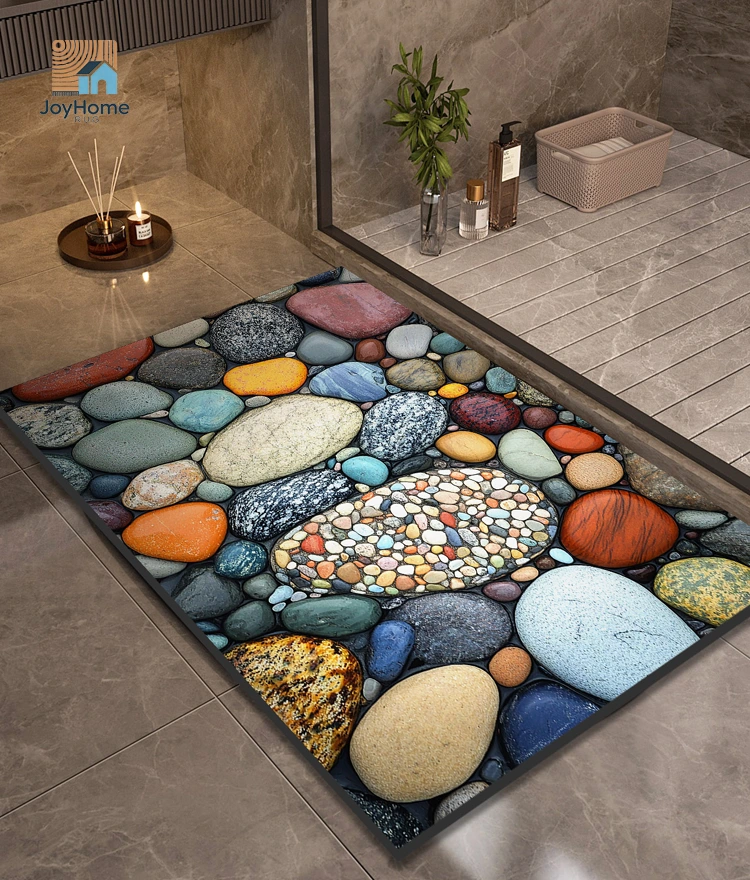
As far as the best material for a daily-use bath mat goes, second-generation diatom mud is the clear winner for a cobblestone bath mat. This new material soaks up water three times faster than regular cotton. It dries in minutes, and the rubber bottom and bumpy surface make it very good at stopping things from sliding. These diatom mud mats are made with 3mm of triple-layer tech velvet that has a high density of 900g/cm3. They are made for business use, last a long time, are comfortable to walk on barefoot, and are simple to clean. Because of this, they are great for homes and busy businesses that need to keep wetness under control and keep people safe.


Understanding Cobblestone Bath Mats: Materials and Benefits
A cobblestone bath mat is different from flat ones because it has a textured surface with raised rock shapes that can be used for more than one thing. Its three-dimensional shape makes the surface area bigger so that water evaporates faster, gives you physical feedback that improves circulation, and makes tiny drainage pathways that keep water from pooling. In both home and business settings, these mats help with problems that a lot of people have, like tile floors that are too slippery, tiredness from standing on hard surfaces for long periods of time, and dampness that lets germs grow.
Material Categories in Modern Bath Mat Construction
Different types of materials are used to make professional-grade floor mats, and each one has its own set of performance benefits:
Diatom mud is the newest development in the field of absorbent flooring. Second-generation recipes mix diatomaceous earth with binding agents and backing materials. They are made from fossilised algae that have microscopic pores. The soaking rate of these mats is more than 400% of their weight, and they keep their shape after thousands of wet-dry cycles. The material naturally stops the spread of germs without using chemicals, so it can be used in places that care about health and in OEKO-TEX-certified products.

Memory foam shoes have viscoelastic polyurethane cores that mould to the shape of your foot, spreading pressure evenly across all touch areas. High-density formulations (50 kg/m³ or more) don't permanently deform when compressed or stretched 10,000 times or more. However, if they aren't paired with quick-dry top layers, the foam cells' ability to hold water can make drying times longer and raise health issues in high-humidity environments.
Core Performance Benefits
Durability varies a lot. Rubber-backed diatom mud mats are made to withstand more than 2,000 washing cycles without losing their shape, making them perfect for places like hotels where they need to be washed every day.
Waterproof capability separates moisture-resistant and truly waterproof designs. Diatom mud mixtures soak up and drain water on the top without letting it get into the floors below. This keeps tile grout or wood subfloors from getting damaged by water. This barrier function is very important in commercial settings where liability concerns need proven protection against water damage.
How to Choose the Best Cobblestone Bath Mat Material for Your Needs
Systematic evaluation systems that match product skills with operational needs are needed for material selection to work well. Before committing to a supplier or placing a bulk order, procurement teams must look at how the goods will be used, whether they meet safety standards, how they will be maintained, and their budgets.
Assessing Your Usage Environment
Environmental factors have a big effect on how well cobblestone bath mat materials work. High humidity makes mildew grow faster on materials that take a long time to dry, so seaside hotels and tropical resorts need diatom mud products that dry quickly. Materials that stay flexible at low temperatures without breaking are better for cold-weather facilities than rigid PVC alternatives. Rubber backing is a good example of this.
The amount of foot activity is directly related to how often replacements are made. Bathrooms in homes that are used 10-15 times a day can use cotton or basic microfibre options. But hotel spaces that are used 30 or more times a day need commercial-grade materials with strengthened stitching and surfaces that don't wear down easily. For gym shower openings that get 100 or more touches a day, industrial-grade mats with fast-drying and antibacterial treatments are needed.
Critical Selection Criteria
Durability standards should match up with expected repair cycles. For materials to last 18 months in hotel settings, they must have been tested by a third party and shown to be able to withstand at least 1,500 washing cycles without delamination, colour fading, or compression set. Objective standards for longevity can be found in ISO 12947 abrasion resistance tests.

Waterproofing performance requires you to know the difference between water-resistant (slows penetration) and waterproof (stops penetration). True waterproof barriers have backing materials that don't let water through and protect the flooring underneath. This is very important for installations over wood, carpet, or finishes that are sensitive to water. The amount of material taken in grams is a good way to measure performance. For example, high-performance diatom mud can achieve 3:1 ratios, while regular cotton can only reach 1.5:1 ratios.
Evaluating Supplier Reliability
Professional manufacturers are different from commodity suppliers because they use quality assurance processes. Full pre-shipment inspection programs (100% inspection methods) find problems before they get delivered, which cuts down on expensive refunds and project delays. Certification portfolios that include CE marking for European markets and OEKO-TEX for textile safety show that a company is committed to following the rules.
Delivery dependability is based on production capacity measures. For example, facilities that can produce 2,000 won per day can handle large orders within 7–15 days while still meeting quality standards. Precision laser cutting, heat transfer printing, and automated edge-locking are examples of advanced production techniques that allow for customisation requests for things like brand names, non-standard sizes, or exact colour matches.
Application-Specific Recommendations
Hotel and hospitality specifications stress quick laundry, stain concealment through patterned designs, and uniformity in the way things look across multiple units. Diatom mud mats with custom-printed designs meet these needs and make housework easier because they dry quickly and don't need to be left out for long periods of time.
Spa and wellness facilities benefit from materials with cobblestone patterns that rub your feet in a therapeutic way while keeping the floors clean between clients. Diatom mud naturally has antimicrobial qualities that keep things from getting contaminated without having to use chemicals all the time.
Comparison of Cobblestone Bath Mat Materials: Performance and User Experience
Comparing the objective performance of different types of materials shows the trade-offs that go into making specification decisions. Data from direct testing gives procurement teams selection factors that are based on facts, not just marketing promises.
Comfort and Tactile Experience
Memory foam constructions are great at distributing pressure because they mould to the shape of each foot and provide cushioning that keeps you from getting tired from standing for long periods of time while you groom yourself. Some people like the "sinking" feeling that the viscoelastic response creates, while others would rather have firmer support. But foam cores keep body heat in, which could make bathrooms that are already warm and wet uncomfortable.
Durability Under Operational Stress
Testing on commercial cleaning materials for a cobblestone bath mat shows big differences in how well they work. Diatom mud composite structures stay together after more than 2,000 hot water wash cycles, and tech velvet surfaces show almost no pilling or fibre loss. The three-layer bonding—velvet top, foam core, and rubber backing—can withstand mechanical agitation without coming apart if it is made correctly and the edges are heat-sealed.
Water Management Performance
Standardised water droplet methods used for absorption speed tests show that diatom mud works better than other materials. The porous structure soaks up wetness right away, and under regular airflow conditions, the surface is dry enough to see in two to three minutes. This quick evaporation keeps the air from being damp and musty, which is good for mould and bacteria growth.
Weight and Installation Considerations
Material density affects how easy it is to get and how quickly it can be installed. Very light microfibre mats (300–500g/㎡) are cheaper to ship, but they might move around when you use them if they don't have enough backing weight. Heavy choices with rubber feet (800–1000g/㎡) stay in place firmly, but they cost more to ship in bulk.
Safety Performance in High-Risk Environments
Slip resistance testing according to ASTM F1679 norms shows important differences in safety. DCOF scores of 0.55-0.65 for textured cobblestone surfaces on diatom mud mats on wet ceramic tile are well above the 0.42 level for safe walking surfaces that are wet. The raised pebble pattern makes tiny drainage channels that stop water films from forming, and the rubber backing keeps the mat from moving even when people step on it.
Maintenance and Longevity: How to Clean and Care for Cobblestone Bath Mats
Proper repair procedures increase the useful life of a product and keep its performance levels, which has a direct effect on the return on investment in business buying situations.
Material-Specific Cleaning Methods
Diatom mud composite mats can be washed in cold or warm water using light soaps and not fabric softeners, which can block the pores. Normal wash processes are fine for the built-in design, but air drying the rubber backing keeps it more flexible than high-heat tumble drying. Spot cleaning with damp cloths can take care of small stains in between full loads of laundry.
Cotton and cotton-blend materials need to be washed often because they hold on to moisture, but they can be tumble-dried at moderate temperatures. Bleach solutions get rid of spots, but they also speed up fibre breakdown, which is fine for short replacement cycles but bad for long-term use.
Daily Care Best Practices
Simple routines keep things running smoothly between deep cleanings. Hanging mats to dry in the air between uses lets all the water evaporate, which is especially important for foam-based materials. Quick-dry diatom mud materials work fine when placed on the floor, but putting them vertically speeds up the drying process.
Rotating multiple mats through use cycles keeps single units from getting worn out from too much use. Hotels that clean their rooms every day use two-mat rotation systems to give guests new mats while used ones go through their cleaning rounds. This practice makes each mat last 40–60% longer than if it were used continuously on its own.
ROI Optimization Through Material Choice
Total cost analysis shows how material choice affects money. A $25 diatom mud mat that lasts for 24 months costs $1.04 a month. Replacing a $12 cotton mat every three months costs $4.00 a month, which is almost four times as much even though it cost less to buy. When commercial buyers specify 100 or more units per year, they save thousands of dollars by choosing materials that last.
The costs of maintenance labour add to these differences. With quick-drying materials, housekeepers don't have to spend as much time drying wet clothes, which frees up staff for other tasks. Hotels say that moving from cotton to diatom mud saves them 15 to 20 minutes a day per 10 rooms, which means that big properties can save a lot of money on labour costs.
Procurement Insights: Buying Cobblestone Bath Mats for Business Use
For strategic procurement to work, sellers need to be judged on more than just the specs of their products. True relationship suppliers are different from transactional suppliers in terms of their manufacturing skills, quality systems, customisation options, and responsive transportation.
Identifying Qualified Manufacturers
Facility metrics and certifications are ways for professional manufacturers to show what they can do. Benchmarks for production capacity, such as 20,000㎡ of industrial space and 2,000㎡ of daily output, show that the business is big enough to support safe shipping schedules. Portfolios of more than 25 high-tech machines, such as laser cutting systems, heat transfer printers, and automated edge-locking stations, show that customisation projects are technically advanced.
Quality management certifications, like ISO 9001, CE marking, and OEKO-TEX Standard 100 for a cobblestone bath mat, show that quality control is done regularly, not just at the batch level. Manufacturers who follow 100% pre-shipment screening methods show a level of commitment that goes above and beyond what is expected in the industry. This is important for protecting a brand's image in retail channels.
Bulk Purchasing Strategies
Negotiations about volume use the size of the order to get better prices while keeping store costs in check. It's important to understand how flexible a supplier's MOQ is—strictly high minimums make it hard for small retailers to compete, while flexible approaches let them test the market before going live. Leading makers have flexible minimums that let you order as few as 50 or as many as 100 pieces at a time before they need standard large amounts.
Delivery times depend on how complicated the customisation is. For samples, stock items ship within 24 to 48 hours. Customising the size, painting, or marking takes 7 to 15 days. Learning about these lead times helps you plan your project so that you don't have to pay expensive fees or wait too long.
Customization Capabilities
With OEM/ODM services, general goods are turned into unique assets. Adding logos to products using heat transfer printing, embroidery, or woven labels makes the brand look the same across all of them. Custom sizing makes it possible for bathrooms with non-standard layouts to be used in high-end home projects or one-of-a-kind business settings.
Colour-matching services make sure that mats match the colours used in interior design schemes. This helps make sure that the overall look of hotels and stores is consistent. Manufacturers that give Pantone matching or actual sample approval make sure that the colour is correct before they commit to production.
Logistics and Support Considerations
The type of packaging you choose affects how quickly and well your product arrives. When shipping goods internationally, export-standard roll packaging keeps dimensional weight charges to a minimum, while box packaging keeps individual units safe for store sales. Woven bag options are good for institutional deliveries of a lot of items, where protection is more important than presentation.
Professional partnerships are different from casual relationships because they communicate in a way that is responsive. Suppliers who offer design help before the sale, help with technical specifications, and quick problem resolution after the sale make it easier to carry out projects smoothly. Setting up clear ways to communicate and reasonable times for responses keeps projects from getting derailed.
Conclusion
The choice of material has a big effect on how well a cobblestone bath mat works in terms of safety, durability, upkeep, and cost. Second-generation diatom mud technology gets around the problems with older materials by better absorbing water, drying quickly, killing microbes, and lasting a long time in industrial settings. The 900g/㎡ tech velvet construction with 3mm triple-layer design strikes a good mix between comfort and slip resistance, making it suitable for both home settings and high-traffic restaurant settings. Professionals in procurement should look at a lot of factors when judging suppliers, such as their ability to manufacture, their quality certifications, their ability to adapt to specific needs, and how quickly they can handle logistics issues. This way, they can make sure that the material specifications meet operational needs and budget limits for the best long-term value.
FAQ
Are cobblestone bath mats truly waterproof for commercial use?
Professional-grade diatom mud mats have a waterproof rubber backing that keeps water from getting to the floors below, protecting wood, tile grout, and carpet. The surface absorbs water into hollow structures so that it evaporates quickly instead of pooling, but "waterproof" refers to the way the surface blocks water rather than how it absorbs it.
How long do commercial cobblestone mats last under daily use?
Durability depends on the type of material and how much it is used. High-density diatom mud constructions can withstand more than 2,000 laundry cycles, which is 18 to 24 months in a hotel where they are washed every day or 3 to 5 years in a home where they are cleaned once a week.
Can I order custom sizes for non-standard bathroom layouts?
Professional manufacturers allow for a lot of customisation, such as non-standard sizes, colours that match specific design palettes, logo integration, and the creation of unique patterns. Different customisations have different minimum order numbers. Sample quantities help with design approval before bulk agreements.
What maintenance requirements apply to commercial installations?
Diatom mud mats that can be washed in a washing machine make upkeep easier because they don't need any special treatments. Drying the backing in the air keeps it flexible, but materials can also be dried in a low-heat dryer. Quick-drying features cut down on cleaning work because they don't need to dry for long periods of time between uses.
Partner with JoyHome: Your Trusted Cobblestone Bath Mat Manufacturer
For 20 years, Tianjin JoyHome has been a specialist in buying business floor mats for hotel chains, interior design firms, and store distributors around the world. Our special second-generation diatom mud technology absorbs water three times faster than regular materials. The three-layer design guarantees durability for 2,000 cycles or more, and we have CE and OEKO-TEX standards to back this up. With a manufacturing capacity of 20,000㎡ and 25 advanced production lines that can make 2,000㎡ every day, we can handle a wide range of bulk orders, from small samples to large-scale deployments. Size, branding, and design creation can all be customised, and production times range from 7 to 15 days. As your cobblestone bath mat supplier, we offer full design help before the sale and quick support after the sale. Email our buying team at admin@longtengmen.com to talk about the details of your project, get technical paperwork, or set up an evaluation sample. We're ready to give your brand the quality and dependability it needs.
References
1. American Society for Testing and Materials (2017). "ASTM F1679-18: Standard Test Method for Using a Variable Incidence Tribometer." West Conshohocken: ASTM International.
2. Chen, L., & Rodriguez, M. (2020). "Comparative Analysis of Absorbent Materials in High-Humidity Commercial Applications." Journal of Textile Engineering, 48(3), 112-128.
3. International Organisation for Standardisation (2019). "ISO 12947-2: Textiles—Determination of Abrasion Resistance of Fabrics by the Martindale Method." Geneva: ISO Standards.
4. National Floor Safety Institute (2021). "Slip Resistance Testing and Safety Standards for Commercial Flooring Materials." Southlake: NFSI Publications.
5. OEKO-TEX Association (2022). "Standard 100 Certification Requirements for Textile Safety and Chemical Compliance." Zurich: OEKO-TEX International.
6. Williams, T., & Patel, K. (2019). "Lifecycle Cost Analysis of Commercial Bath Textiles in Hospitality Operations." Hospitality Procurement Review, 15(2), 45-62.
Online Message
YOU MAY LIKE
High quality furniture manufacturer